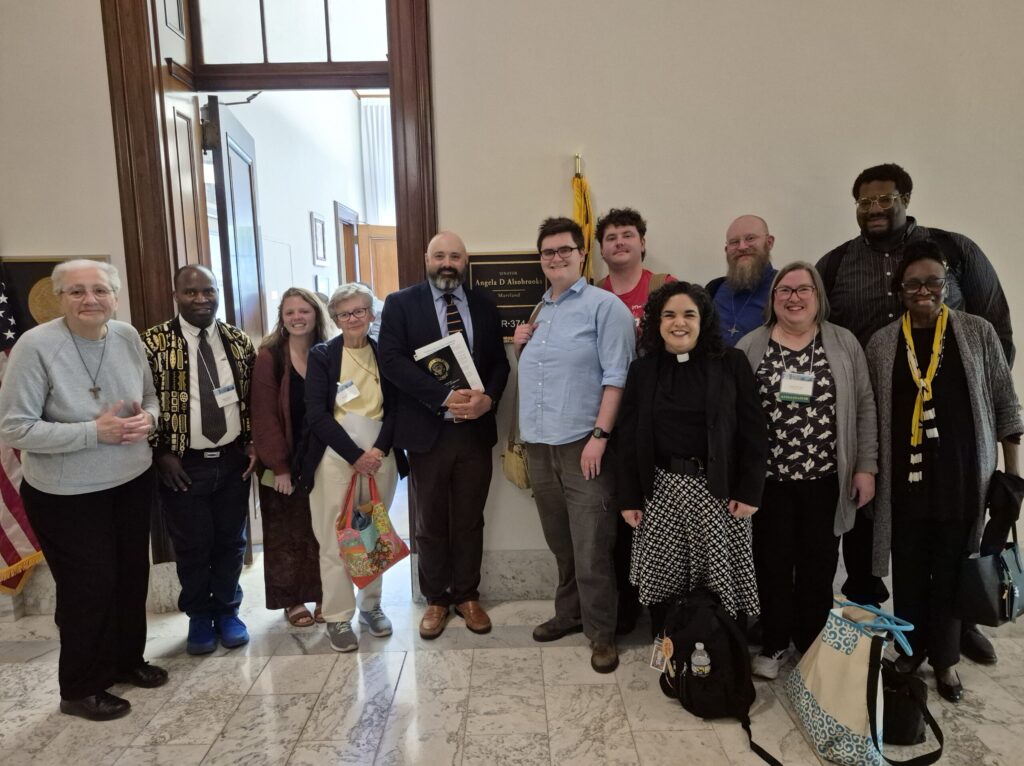
From April 20–22, 2026, the Ecumenical Advocacy Days (EAD) National Gathering convened in Washington, DC under the theme “Protecting People, Peace, and Planet.”¹ The gathering reaffirmed that advocacy is not peripheral but essential to Christian discipleship. For the Africa Faith and Justice Network (AFJN), this commitment flows from the conviction that faith must shape public engagement, particularly in confronting injustice. The event culminated in a coordinated day of congressional advocacy on April 22—intentionally aligned with Earth Day—highlighting the intrinsic link between care for creation and the dignity of the human person.²
Rooted in biblical witness and the ecumenical tradition of justice and peace, the gathering provided space for both theological reflection and policy engagement. For AFJN, participation is not merely civic involvement but a concrete expression of faith in action, consistent with Catholic social teaching on the Church’s responsibility to help shape the moral dimensions of public life.³ As an active EAD member, AFJN continues to contribute through both sponsorship and direct advocacy engagement.
A Pan-African Voice in U.S. Policy
As a Pan-African organization, AFJN brings a transnational perspective to U.S. advocacy, recognizing that domestic policies often have far-reaching consequences for African migrants and diaspora communities. This approach reflects the Church’s principle of solidarity, which calls for recognition of our shared humanity across borders.⁴ The lived realities of African migrants—whether navigating immigration systems or accessing essential services including disaster reif, —underscore the need for advocacy grounded in both moral conviction and lived experience.
Migration and Human Dignity
Catholic teaching speaks clearly to this issue. In Fratelli Tutti, Pope Francis insists that migrants must never be reduced to problems to be managed, but recognized as persons whose dignity is inviolable.⁵ Migration policy, therefore, must be guided by fraternity, justice, and respect for human dignity, regardless of legal status. AFJN supports EAD’s call for a more humane and just migration system. The practice of deporting migrants to third-party countries, including African nations, frequently exposes individuals to hardship, instability, and systemic injustice.
Justice in Disaster Response
EAD also emphasized the need for equitable access to disaster relief. While natural disasters affect entire communities, vulnerable populations—including migrants—often encounter barriers to assistance. Exclusion based on legal or social status undermines both justice and human dignity. This concern aligns with the Church’s preferential option for the poor and vulnerable, a foundational principle of Catholic social teaching.⁶
Care for Creation and Integral Ecology
The alignment of advocacy efforts with Earth Day underscores the inseparability of environmental and social concerns. In Laudato Si’, Pope Francis articulates the vision of integral ecology, reminding us that the “cry of the earth” and the “cry of the poor” are inseparable.⁷
For African communities, both on the continent and in the diaspora, this interconnected reality is especially evident. Environmental degradation, forced displacement, and economic vulnerability are deeply intertwined, requiring responses that are holistic, just, and sustainable.
Legislative Priorities
As part of its advocacy on Capitol Hill, AFJN aligned with EAD call to members of Congress to support these key legislative measures that reflect these moral commitments:
- H.R. 4669 – FEMA Act of 2025 (House version): This bill would elevate the Federal Emergency Management Agency (FEMA) to a cabinet-level agency, improving coordination and ensuring disaster response remains centered on affected communities. It also proposes simplifying aid applications, strengthening mitigation efforts, and increasing transparency through a public accountability dashboard overseen by the Government Accountability Office.⁸
- H.R. 1061 / S. 455 – Protecting Sensitive Locations Act: This legislation would restrict immigration enforcement in sensitive locations such as schools, places of worship, hospitals, and courthouses, and extend protections within a 1,000-foot radius of additional essential spaces.⁹
- H.R. 924 / S. 398 – NO BAN Act (National Origin-Based Antidiscrimination for Nonimmigrants Act): This bill would bar presidents from imposing sweeping, discriminatory travel bans based on nationality or religion. It strengthens nondiscrimination provisions in immigration law, requires credible evidence and interagency consultation for any future restrictions, and enhances congressional oversight of executive actions related to entry bans.10
Together, these measures reflect a broader moral imperative to safeguard human dignity and protect spaces essential to life, care, and community.
A Call to Faithful Witness
In a time marked by migration crises, environmental challenges, and widening social inequities, the call to protect people, peace, and the planet remains urgent. Grounded in Catholic social teaching, AFJN continues to advocate for policies that uphold human dignity, advance the common good, and promote a more just and compassionate society.
Footnotes
¹ Ecumenical Advocacy Days, “2026 National Gathering: Protecting People, Peace, and Planet,” official program materials, accessed 2026, https://advocacydays.org/2026-protecting-people-peace-and-planet/
² Earth Day Network, “History of Earth Day,” accessed 2026, https://www.earthday.org/history/
³ Gaudium et Spes, no. 43, accessed 2026, https://www.vatican.va/archive/hist_councils/ii_vatican_council/documents/vat-ii_const_19651207_gaudium-et-spes_en.html
⁴ John Paul II, Sollicitudo Rei Socialis, no. 38, accessed 2026, https://www.vatican.va/content/john-paul-ii/en/encyclicals/documents/hf_jp-ii_enc_30121987_sollicitudo-rei-socialis.html.
⁵ Francis, Fratelli Tutti, nos. 39–40, accessed 2026, https://www.vatican.va/content/francesco/en/encyclicals/documents/papa-francesco_20201003_enciclica-fratelli-tutti.html
⁶ Pontifical Council for Justice and Peace, Compendium of the Social Doctrine of the Church, nos. 182–184, accessed 2026, https://www.vatican.va/roman_curia/pontifical_councils/justpeace/documents/rc_pc_justpeace_doc_20060526_compendio-dott-soc_en.html
⁷ Francis, Laudato Si’, no. 49, accessed 2026, https://www.vatican.va/content/francesco/en/encyclicals/documents/papa-francesco_20150524_enciclica-laudato-si.html
⁸ U.S. Congress, H.R. 4669, “Fixing Emergency Management for Americans Act of 2025” / FEMA Act of 2025, legislative text, https://transportation.house.gov/uploadedfiles/fema_act_of_2025_introduced_text.pdf
⁹ U.S. Congress, H.R. 1061 / S. 455, “Protecting Sensitive Locations Act,” legislative text, https://www.congress.gov/bill/119th-congress/house-bill/1061/text and https://www.congress.gov/bill/119th-congress/senate-bill/455
10. U.S. Congress, H.R. 924 / S. 398 – National Origin-Based Antidiscrimination for Nonimmigrants (NO BAN) Act, legislative text, accessed 2026, https://www.congress.gov/bill/119th-congress/house-bill/924 and https://www.congress.gov/bill/119th-congress/senate-bill/398
Read the flier that was distributed to members of Congress during the EAD advocacy visits.