From Import Dependency to Health Sovereignty: Investing in Uganda’s Herbal Medicine Heritage
Thursday, September 24, 2026
by Jacques Bahati
Posted in AFJN Chapters, AFJN-Uganda, Advocacy, Contact Africa Govt, Focus Campaigns, Just Governance
Tagged in Region (Central Africa), Region (Eastern Africa)

Africa carries roughly a quarter of the global disease burden but produces only about 3% of the world’s medicines. Uganda alone spends an estimated US$500 million or more each year importing pharmaceuticals it could partly produce at home — a recurring drain on foreign exchange and a missed opportunity for Ugandan farmers, researchers, and factory workers.
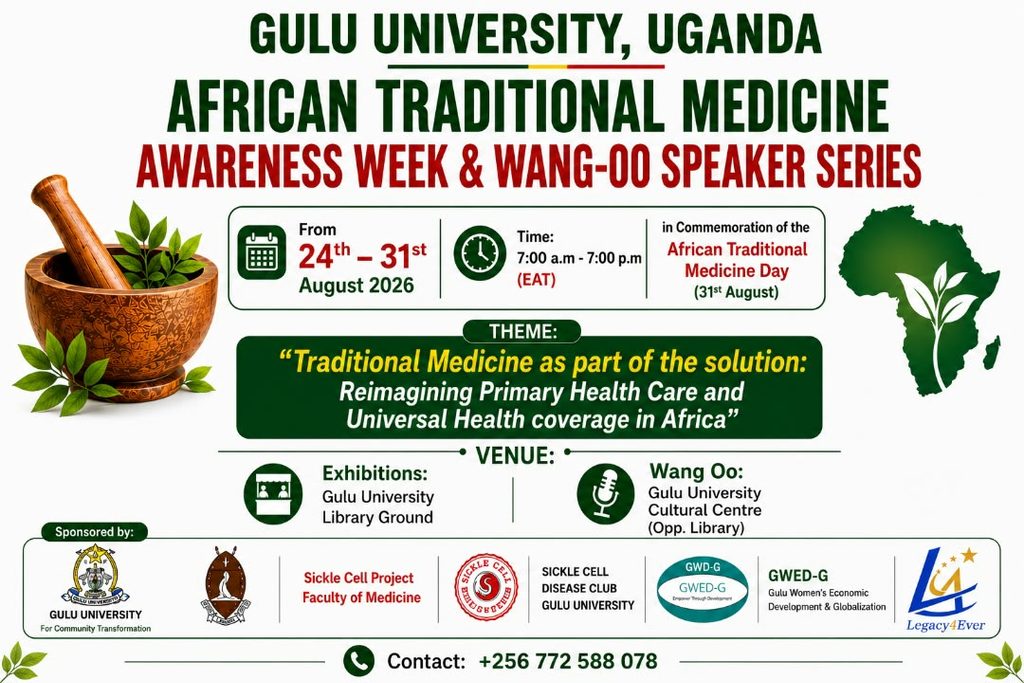
At a symposium organized during Gulu University’s National African Traditional Medicine Day programme on 30 August 2026, Ntama B. Bahati, Senior Policy Analyst and Steven Nabieu Rogers, PhD, Executive Director of the Africa Faith and Justice Network (AFJN), presented “From Import Dependency to Health Sovereignty: Investing in Uganda’s Herbal Medicine Heritage”, a paper arguing that investing in African herbal medicine is not merely a health intervention but a justice imperative — one that honours African indigenous knowledge, creates economic opportunity, and strengthens national self-reliance.
The paper’s most striking contribution is its insistence on a paradigm change in how African medicine is named. For generations, African plant-based medicine has been called “traditional,” while the same products made in Europe or Asia are labelled “herbal medicine” or “phytomedicine.” They argue that the distinction is not value neutral, but rather it shapes which products are trusted, which are funded, and which command higher prices.
The Paradigm Change: Words That Decide Value
The authors retire “traditional medicine” as a default term and replace it with five deliberately chosen ones: African Herbal Medicine — the product itself: extracts, tinctures, capsules, or tablets formulated for a specific condition. African Indigenous Knowledge — the orally transmitted, community-held body of diagnostic reasoning and accumulated observation. African Medical Knowledge System — the full institutional framework: diagnosis, therapy, prevention, apprenticeship, and community health infrastructure. African Ethnomedicine — the internationally recognized academic field of ethnomedicine and ethnopharmacology. African Pharmacopeia — the codified, standardized formulary of monographs, dosages, and clinical indications.
Drawing on philosophers Miranda Fricker, Boaventura de Sousa Santos, and Paulin Hountondji, the authors argue that language is the first site where value is assigned or withheld. Standardizing these five terms nationally and continentally is an act of justice, not style.
The Cost of Forgetting: Prunus africana
The paper offers a cautionary case study. Prunus africana — the African cherry — has treated prostate and urinary conditions in African indigenous knowledge for generations. Today, Ugandan harvesters collect bark for as little as US$2–6 per kilogram. That bark is shipped to Europe, where two firms in France and Italy process approximately 86% of the world’s bark extract. Finished capsules return to Uganda as expensive imports.
The lesson: without local processing, standardization, and manufacturing capacity, Uganda’s forests fund pharmaceutical companies abroad more than they fund Ugandan health or livelihoods.
The Economic Case
If Uganda developed and approved high-quality herbal medicines to replace just 20–30% of the medicines it currently imports, the country could keep an estimated US$100–150 million each year in the local economy. This money could support farmers growing medicinal plants, local manufacturers processing them, and pharmacies selling the finished products. The knowledge base already exists: an estimated 60% of Ugandans seek care from traditional and complementary medicine providers, and the ratio of traditional health practitioners to people is approximately 1:200–400, compared to 1 doctor per 20,000 people.
Policy Momentum — and the Gap
Uganda has laid significant groundwork: the 2000 National Health Policy recognizes African herbal medicine; the 2019 Traditional and Complementary Medicine Act creates a National Council to license practitioners; and the Natural Chemotherapeutics Research Laboratory serves as Uganda’s dedicated public research body. Yet the policy architecture exists on paper without a funded pipeline to make it real. Former Agriculture Minister Victoria Sekitoleko has called the 2019 Act “dead on arrival” under the Ministry of Health and urged a separate ministry.
Momentum is building nonetheless. In 2024, healers from more than 18 organizations formed the Re-Union of Traditional Healers and Herbalists Association. The National Drug Authority signed an MOU with the Buganda Kingdom to train herbalists toward Good Manufacturing Practice standards. And in 2026, President Museveni endorsed herbalist David Ssenfuka’s cancer and diabetes formulations as a national treasure.
Five Investments Suggestions
1. Fund the research pipeline — Budget line for the Natural Chemotherapeutics Research Laboratory and university units at Gulu and Makerere. 2. Finish and resource the Traditional & Complementary Medicine Act of 2019 — Fully implement the National Council with a budget to license practitioners and set enforceable safety standards. 3. Legislate benefit-sharing — Enact access-and-benefit-sharing rules so knowledge-holders and communities profit alongside investors. 4. Incentivize local manufacturing — Tax incentives and GMP-upgrade support for domestic production. 5. Protect the raw material base — Fund cultivation and conservation of medicinal plants under commercial pressure, including the Convention on International Trade in Endangered Species (CITES)-listed species.
Government First, Not Government Only
Government investment is necessary but not sufficient. The paper further argues that government leadership is critical to de-risking every other input. A private investor cannot license a product with no legal pathway to registration; a philanthropic funder cannot underwrite research with no public laboratory. Government must go first — and then a wider coalition of diaspora capital, impact investors, pharmaceutical partners, philanthropic and faith-based networks, and university and multilateral partners can build alongside it.
The authors stress this is not a single appeal but a sustained, multi-generational campaign. Uganda will always need medicine. The grandmothers in the village whose African indigenous knowledge has never been given a budget deserve to see that knowledge valued, researched, and defended by a campaign built to last as long as the need for medicine does.