
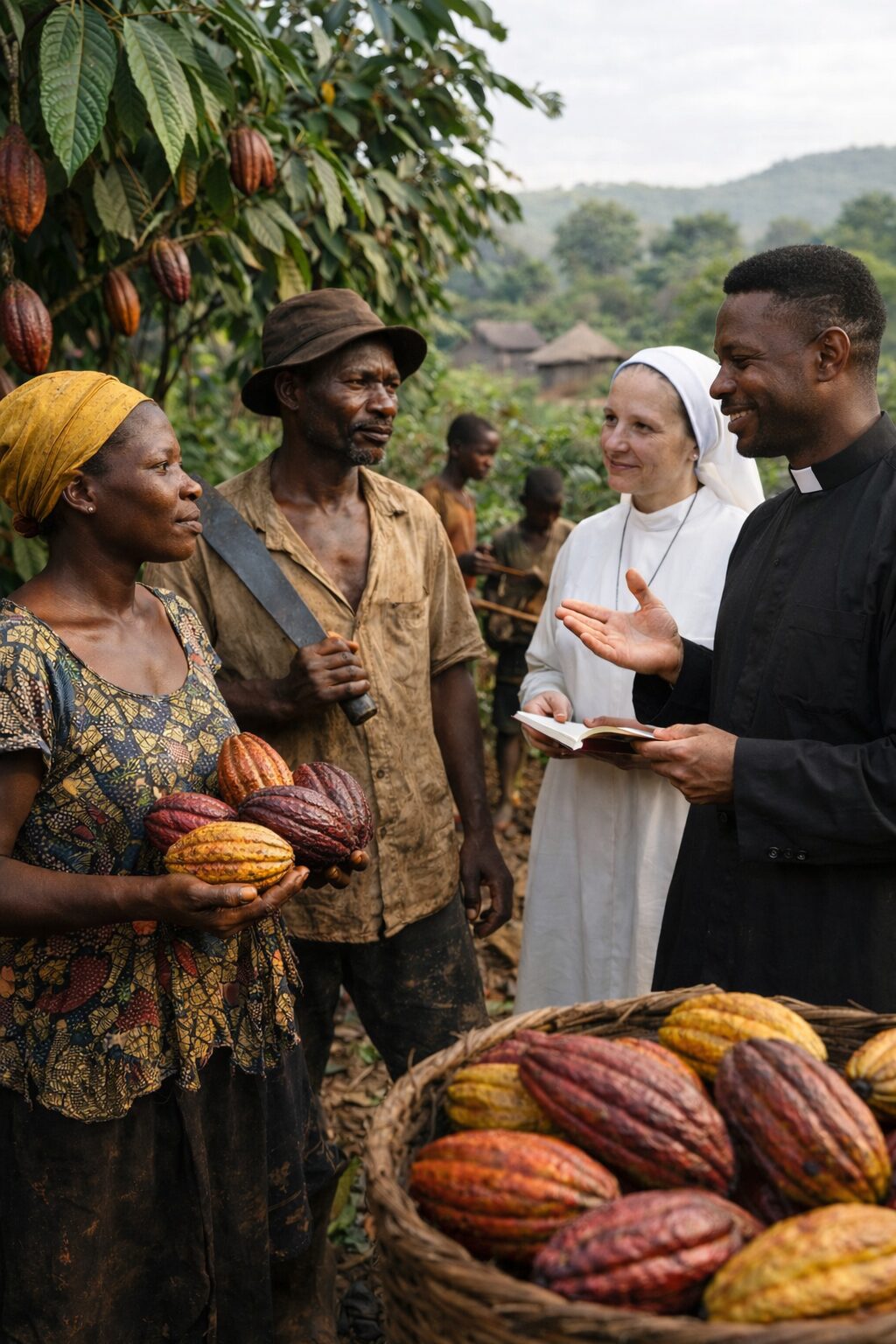
Image generated by AI.
Cocoa is one of the world’s most important agricultural commodities, sustaining millions of families across Africa, Latin America, and Asia. Yet the farmers whose labor makes this global industry possible often struggle to meet even their most basic needs. This contradiction raises a fundamental moral question rooted in Catholic social teaching: can an economic system be considered just when those who produce its wealth remain poor?
The Catholic Church teaches that economic life must uphold human dignity and that societies must evaluate policies by how they affect the most vulnerable. This is the essence of the preferential option for the poor, described in the Compendium of the Social Doctrine of the Church as a “fundamental choice” that must shape social, economic, and political decisions.¹ When applied to the cocoa sector, this teaching compels governments, companies, and consumers to ask whether the people who work the hardest receive a fair share of the value they create.
Cocoa farmers form the foundation of a multibillion‑dollar global industry, yet many smallholders face persistent hardship. Prices often fail to cover production costs, payments are sometimes delayed for months, and rural communities frequently lack adequate schools, healthcare, and infrastructure. These conditions reveal a profound imbalance between global profit and local poverty. Catholic social teaching insists that work is not merely a commodity but a human activity that participates in God’s creative action. When work does not allow a family to live in dignity, the economy has failed in moral terms, even if it appears successful commercially.²
The Africa Faith and Justice Network (AFJN) approaches the cocoa crisis through this moral lens. Its mission is rooted in the Church’s insistence that the poor must be at the center of public life. Pope Leo XIV’s apostolic exhortation Dilexi te reinforces this principle by calling the Church to a “decisive and radical choice in favor of the weakest,” who hold a special place in God’s heart because they are poor and oppressed.³ Cocoa farmers are not marginal actors in the global economy; they are its indispensable foundation. Their continued poverty, while others accumulate significant profit, should trouble every government in cocoa‑producing nations as well as the broader international community.
The consequences of injustice are not abstract. In February 2026, the Ghana Catholic Bishops’ Conference warned that many farmers had endured months‑long delays in receiving payment for cocoa already delivered. The bishops described the resulting unpaid labor, school disruptions, rising debt, and deepening vulnerability as evidence that rescuing the cocoa sector is “not merely an economic task” but “a moral imperative.”⁴ AFJN shares this concern. Delayed payment is not a technical inconvenience; it destabilizes families, undermines trust, and erodes the social fabric of rural life. A system that relies on such conditions cannot claim moral legitimacy.
The same moral logic applies to the issue of child labor. AFJN emphasizes that child labor in cocoa cannot be addressed honestly without confronting the poverty that drives it. Broadview’s reporting on child labor in West Africa highlights the scale of the problem and the long‑standing evidence of children involved in cocoa production.⁵ While exploitation is never excusable, the prevalence of child labor reflects the desperation of households whose income is too unstable or too low to meet basic needs. Catholic teaching rejects any economic arrangement that harms children or sacrifices their future. Reducing child labor requires addressing the structural poverty that forces families into impossible choices.
A preferential option for the poor demands structural responses rather than charitable gestures. For cocoa‑producing governments, this means examining whether farm‑gate prices allow families to live in dignity, whether payment systems are prompt and transparent, whether rural schools and clinics are accessible, and whether farmers have a meaningful voice in decisions that shape their lives. Public investment must reach the communities that sustain national export earnings, and national dialogue on cocoa must include farmers themselves, not only traders, political actors, and multinational buyers.
The future of cocoa should not be measured solely by export volumes or international prices. A just cocoa economy must be evaluated by whether farming families can live in dignity, whether children can remain in school, and whether rural communities can envision a stable future. These are the standards of justice set by Catholic social teaching, and they are the reasons AFJN considers the condition of cocoa farmers an urgent matter of faith and justice.
Footnotes
⁴ Ghana Catholic Bishops’ Conference, statement on delayed payments to cocoa farmers.
⁵ Gillian Grace, “Chocolate relies on child labour in Africa’s Ivory Coast, a bitter truth,” Broadview, 31 May 2014, on child labour in West African cocoa production.