DRC
10 Million Dead, Territory Lost: The War in Congo Shows No Sign of Ending
Despite claims of progress, the situation on the ground shows continued violence and increasing signs of de facto partition, in defiance of international appeals for respect of DRC’s sovereignty and territorial integrity.
Press Statement: Africa Faith and Justice Network Cautiously Optimistic about the Brokered Democratic Republic of the Congo and Rwanda Peace Agreement
Friday, the Government of the Democratic Republic of the Congo (DRC) and the Government of the Republic of Rwanda (Rwanda), facilitated by the United States of America (US), signed the “Peace Agreement between the [DRC] and [Rwanda]” marking the most recent attempt to bring peace to a region whose peoples have been suffering for three decades as governments, rebels, and military factions fight over the rights of critical minerals and land.
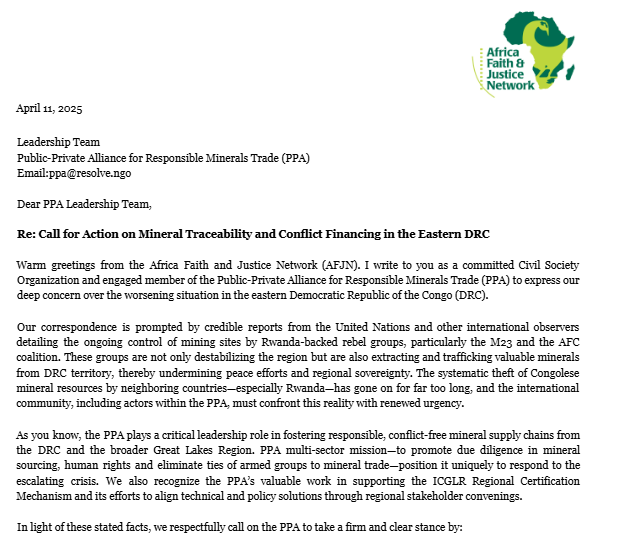
Call for Action on Mineral Traceability and Conflict Financing in Eastern DRC
The Africa Faith and Justice Network, a member of the Public-Private Alliance for Responsible Minerals Trade (PPA), sent the “Call for Action on Mineral Traceability and Conflict Financing in Eastern DRC” letter to the PPA Leadership Team, urging them to take a clear and principled stance of the ongoing crisis in the DRC with particular emphasis on the issue of mineral extraction by unauthorized actors, including armed groups.
AFJN’s Policy Analyst Jacques Bahati featured in joint letter to U.S. Secretary of State
On March 23rd, 2021, the Human Rights Watch featured an article titled “The Need for a US Special Envoy for the Great Lakes Region”.
AFJN’s Policy Analyst Jacques Bahati publishes analysis on DRC
On August 6th, 2021, Africavista published an article titled “Rd Congo, a time bomb” by AFJN’s policy Analyst Jacques Bahati.
AFJN mentioned in Global Witness press release on NGO coalition calling for legislation from EU.
On September 16th, 2016, the Global Witness published a press release titled “Una nueva ley de la UE podría detener el recrudecimiento de los conflictos por el comercio de recursos naturales”.
AFJN’s Jacques Bahati mentioned in San Francisco Bay View
KPFA News Anchor Cameron Jones: On Tuesday the House Foreign Relations Committee held a hearing on the Democratic Republic of Congo, the most lethal conflict in the world since World War II, which has continued since the International Rescue Committee estimated over three years ago that more than 5.4 million people had died in the conflict, most of whom had died of hardship after being driven from their homes.